Save Energy: Small act, big impact
Whether you live in student accommodation, a shared flat or your own apartment, we need energy every day. But heating, showering and electricity all cost money. Especially with energy prices remaining high, it is worth taking a closer look at your own energy consumption. Even small changes can make a difference. By making simple adjustments to heating and hot water usage at home, you can save up to 68%* energy. This can help protect both the climate and your wallet.
We want to help you reduce your energy consumption and contribute to climate protection. To support you, we provide practical tips that are easy to incorporate into your everyday life. At the same time, we are implementing technical and organisational measures to further reduce energy consumption across our facilities. Together, we can make a difference by improving energy efficiency and protecting the climate. Every contribution counts!
Our first topic is heating. This will be followed by practical tips on hot water and electricity. This page will be regularly updated with additional tips and information, so make sure to check back from time to time!
Discover how you can save energy with simple changes. By doing so, you will be helping the climate while saving money at the same time – money you can spend on the things that matter to us and to you.
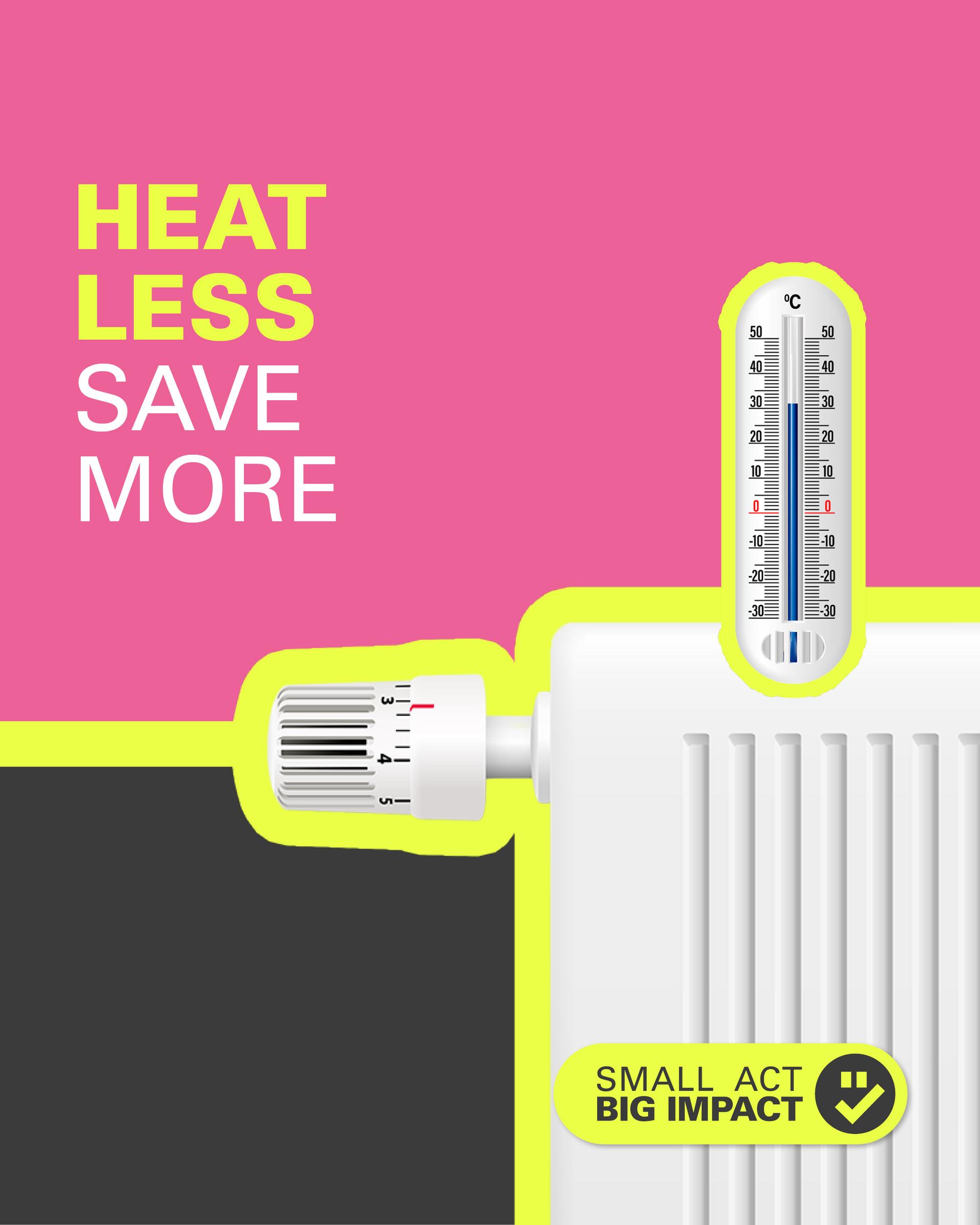
Heat less. Save More.
Even though we don't need heating all year round, it accounts for the largest share of energy consumption in our homes (around 70%*). This also means it offers significant potential for energy savings. Here are our tips:
1. Remove Air from your radiators
If your radiator is making gurgling noises or remains partly cold even when the thermostat is turned up, trapped air may be the cause. You may be able to fix this by releasing the air using a radiator key. In buildings with central heating, it is best to report the issue first rather than attempting to bleed the radiator yourself.
2. Choose your room temperature wisely
Not every room needs to be kept at the same temperature. Think about how you use each space and adjust the heating accordingly.
Did you know? Lowering the temperature by just one degree can reduce energy consumption by around 6%**, helping you save money and reduce CO₂ emissions!
You can adjust the temperature using the thermostat on your radiator:
- Level 1: approx. 12°C
- Level 2: approx. 16°C
- Level 3: approx. 20°C
- Level 4: approx. 24°C
- Level 5: approx. 28°C
- Snowflake (*): Frost protection – the heating only switches on when the temperature drops below approx. 5°C.
- Sun symbol: Recommended daytime temperature, usually around 20°C.
- Moon symbol: Indicates a reduced nighttime temperature of around 14°C.
There are usually three small marks between each numbered setting, representing one-degree increments. A room thermometer can also be useful to help you keep track of the temperature more accurately.
3. Don't heat an empty room
If you won't be using a room for an extended period – for example, overnight or for several days – you can lower the temperature to around 15°C. Especially in older buildings, turning down the heating overnight can save more energy than reheating the room when you return. However, avoid letting rooms cool down completely, as this can increase the risk of damp and mould.
Did you know? Contrary to popular belief, setting your thermostat to the highest level does not heat up a room any faster. A room warms up just as quickly on level 5 as it does on level 3. The numbers on the thermostat simply indicate the target temperature. The higher the setting, the longer the radiator heats, not the faster the room warms up.
Make a difference!
Check the temperature in each room and adjust it according to how you use the space. When leaving a room, turn down the thermostat, for example, to around 15°C. Feeling cold? Put on some warm socks and a sweater before turning up the heating.
If you have them, close your shutters or blinds, just as you would in summer. This helps retain heat in the room and reduces heat loss through the windows.
*co2online, „warmwasserspiegel,“ 13 10 2026.
**G.G f.E.-.G.&.C.KG, „Ganz einfach Energiesparen,“ 13 10 2026.